Tuition fees, diploma recognition, application procedures: the choice between a public art education and a private training program involves very different parameters. This article compares the two pathways based on the criteria that truly matter in a career in art, design, or applied arts.
Registration via Parcoursup or independent competition: two calendars, two strategies
Most public higher art schools and DN MADE programs are integrated into the Parcoursup platform. The student submits their wishes within the national calendar, receives responses at the same pace as other fields, and must adhere to the imposed deadlines.
The majority of private art schools recruit outside of Parcoursup, with competitions or ongoing applications. This discrepancy opens up a concrete possibility: applying later or bouncing back after a rejection from the national platform.
A candidate can thus pursue a public strategy via Parcoursup and a private strategy in parallel, without one negating the other. Understanding the differences between public and private art training allows for anticipating this dual calendar as early as the final year of high school.
Public and private art diplomas: comparative table of recognition
The question of the diploma remains the most misunderstood point. For a long time, only the public circuit guaranteed a title recognized by the State. The situation has changed since the 2018-2022 reform, which allowed many private schools to register their titles with the RNCP.
| Criterion | Public training | Private training |
|---|---|---|
| Diploma awarded | DNA (bac+3), DNSEP (bac+5) – national diplomas | Own title, sometimes registered with the RNCP |
| State recognition | Automatic (under the Ministry of Culture) | Variable: check RNCP registration |
| LMD equivalence | Yes (license for DNA, master for DNSEP) | Yes if the RNCP title is at level 6 or 7 |
| Further studies | Direct access to university master’s programs | Possible with an RNCP title, case by case without |
| Annual tuition fees | Several hundred euros | Several thousand euros |
A private RNCP title now offers equivalence to a license or master’s degree, which secures professional integration. The historical boundary “public = recognized, private = not recognized” no longer corresponds to reality for schools that have taken this step.
The trap remains with private schools that have no registration with the RNCP. Their diploma then has no value in the labor market in a regulatory sense, even if the training may be qualitatively solid.
Selectivity of art schools: public competitions versus private applications
Public higher art schools under the Ministry of Culture (about fifty in France, including 14 national ones) select students through competitions. The candidate presents a portfolio, undergoes an interview before a jury, and sometimes a practical test. The selection is tough: the number of places remains limited by public funding.
In private schools, the process varies. Some organize demanding competitions. Others admit students based on application and motivation interviews, with a significantly higher acceptance rate. The level of entry requirements directly depends on the reputation and positioning of the school.
Three criteria allow for gauging the actual selectivity of a private school:
- The ratio between the number of candidates and the number of available places, when communicated
- The presence of a practical test or a mandatory portfolio, indicating that the school evaluates technical level
- The existence of an integrated preparatory year, which often indicates that the school welcomes less advanced profiles to train them before the main curriculum
Workshop teaching and professional network: what the status really changes
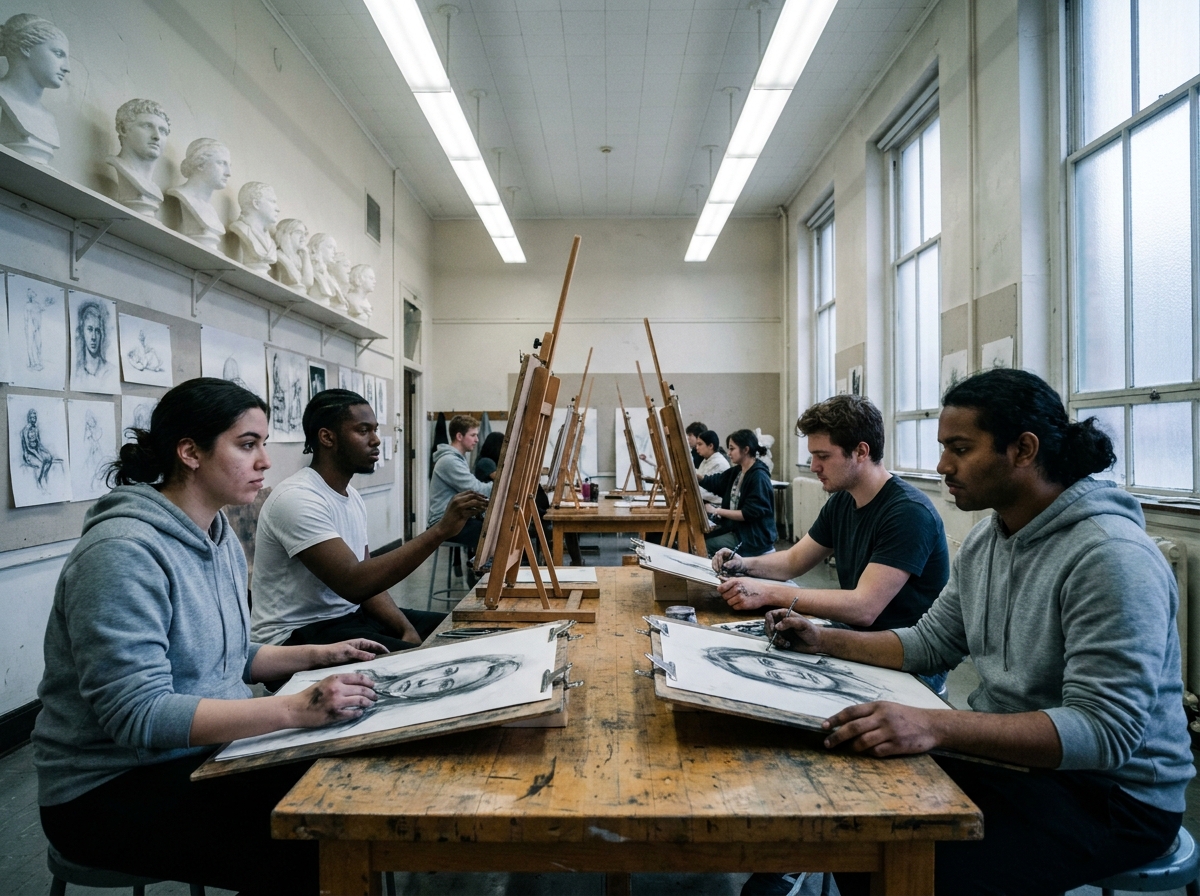
Public art schools historically operate on a model of workshops supervised by active artists. The curriculum alternates practical work, theoretical research, and workshops. Teaching prioritizes experimentation and personal research, sometimes at the expense of immediate professionalization.
Private schools, which depend on their tuition fees, often emphasize employability. Mandatory internships, speakers from companies, projects commissioned by brands: the private curriculum tends to structure the pathway around identified career opportunities (graphic designer, art director, product designer).
This difference in philosophy is not absolute. Some public schools have developed strong partnerships with the professional world, and some private schools allow ample room for free creation. The status does not predict everything.
- In public schools, the alumni network often builds within the contemporary art scene, galleries, and artist residencies
- In private schools, the network is more oriented towards design agencies, creative studios, and artistic directions in companies
- France Travail reports show that the same employment statuses (fixed-term, permanent, freelance, intermittent) are found regardless of the type of school attended

Artistic training budget: real cost beyond registration fees
Registration fees in public art schools are limited to a few hundred euros per year, comparable to university fees. In private schools, the bill reaches several thousand euros annually, sometimes over five years of study.
The total cost exceeds just tuition fees. Materials (art supplies, software, large-format printing), housing in the cities where the schools are located, and competition fees add up in both cases. In public schools, the cost of materials is sometimes shared thanks to equipped workshops, which reduces individual expenses.
A parameter often overlooked: private schools outside the RNCP do not provide access to the student status recognized by CROUS, complicating the acquisition of scholarships and housing in university residences.
The choice between public and private artistic training is not limited to a quality-price arbitration. The application calendar, diploma recognition via the RNCP, pedagogical philosophy, and targeted professional network weigh as much as the budget. Checking RNCP registration before committing to a private school remains the most protective reflex for an art student.