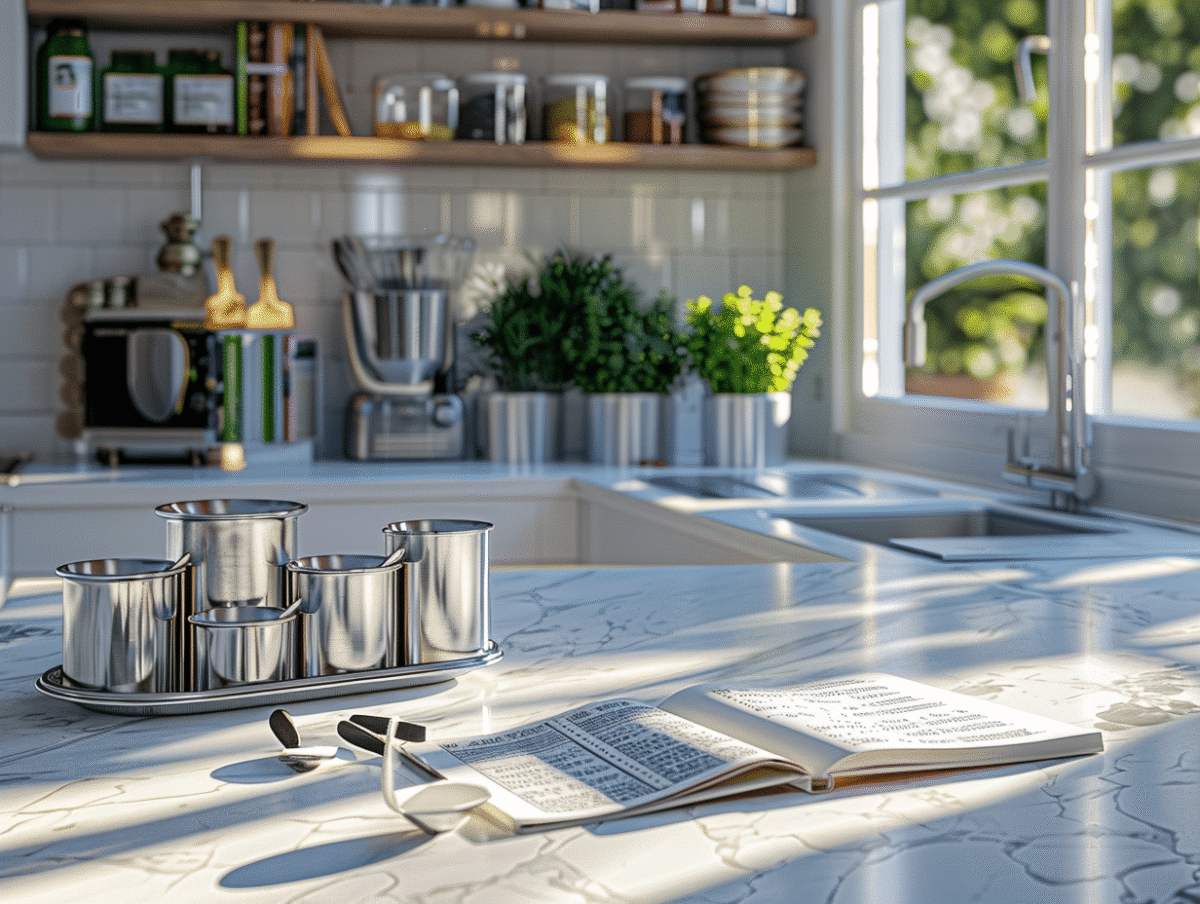
Culinary art is a precise science where each ingredient must be measured accurately to ensure the success of recipes. Chefs, whether amateur or professional, often face instructions involving different units of measurement, whether metric or imperial. Understanding how to effectively convert grams to ounces, milliliters to tablespoons, or degrees Celsius to Fahrenheit is essential for adapting recipes from around the world to your kitchen. Mastering this skill will allow you to avoid risky approximations and create delicious dishes with the precision that gastronomy demands.
The Essentials of Measurement Conversion in Cooking
Measurement conversion in cooking: this concept represents the cornerstone of any culinary achievement where precision is the key to success. Conversion measurements are essential in the kitchen to maintain the proportions of recipes. Indeed, following a recipe often involves juggling between grams, milliliters, and centiliters, not to mention conversions between the metric and imperial systems. A reliable conversion chart is therefore an indispensable tool for any cook who is keen on fidelity to the recipes they aim to create.
To navigate between units of measurement, one must know the basic equivalences: one centiliter is equivalent to ten milliliters (1 cl = 10 ml), and one thousand grams makes one kilogram (1000 g = 1 kg). These standards allow for the conversion of volume units to weight, depending on the density of the ingredients, and vice versa. For example, converting 125 ml to g of water is simple, as 1 ml of water weighs 1 g. This rule is not universal: the variable density of other ingredients like milk, flour, or sugar requires specific adjustments.
The use of appropriate measuring tools is also fundamental. A teaspoon holds about 5 ml, a tablespoon 15 ml, while a teacup represents 20 cl and a medium glass 10 cl. These everyday utensils can serve as benchmarks for measuring liquids or powdered ingredients, provided they are used with rigor and method.
Consider the variability of conversion depending on the nature of the ingredient: 1 ml of milk is approximately equivalent to 1 g, but 1 cup of flour weighs 100 g, while the same cup of sugar weighs 245 g and butter 240 g. These subtleties, far from being anecdotal, are crucial when it comes to transposing a recipe with the fidelity of a craftsman respectful of their art.

Techniques and Tips for Adapting Recipes Accurately
Adapting recipes accurately can seem complex. However, a few techniques and tips allow you to do it with ease. Start by equipping yourself with a precise kitchen scale and a measuring cup, essential tools for measuring both dry and liquid ingredients. The scale will ensure an accurate weight measurement, while the measuring cup will help you assess volume precisely, thus avoiding conversion errors that could alter the final result of your dish.
For small quantities, spoons are very helpful, provided you respect their capacity: a teaspoon for 5 ml and a tablespoon for 15 ml. Keep in mind that these measurements are standard and that using dedicated cooking spoons is preferable to table cutlery, which can vary in size. A standard teacup will serve as a gauge for 20 cl and a medium glass for 10 cl. These references, although simple, are crucial in the preparation of your dishes where every milliliter can count.
Memorize some key equivalences between weight and volume for the most common ingredients. For example, 1 ml of water weighs 1 g, which greatly simplifies the task for recipes requiring precise liquid measurements. Milk is slightly less dense, with 1 ml being approximately equivalent to 1 g. For powdered ingredients like flour, the sugar density, and the butter density, the weights per cup are respectively 100 g, 245 g, and 240 g. These figures are significant when you need to convert volumes to weights, especially when using foreign or old recipes.