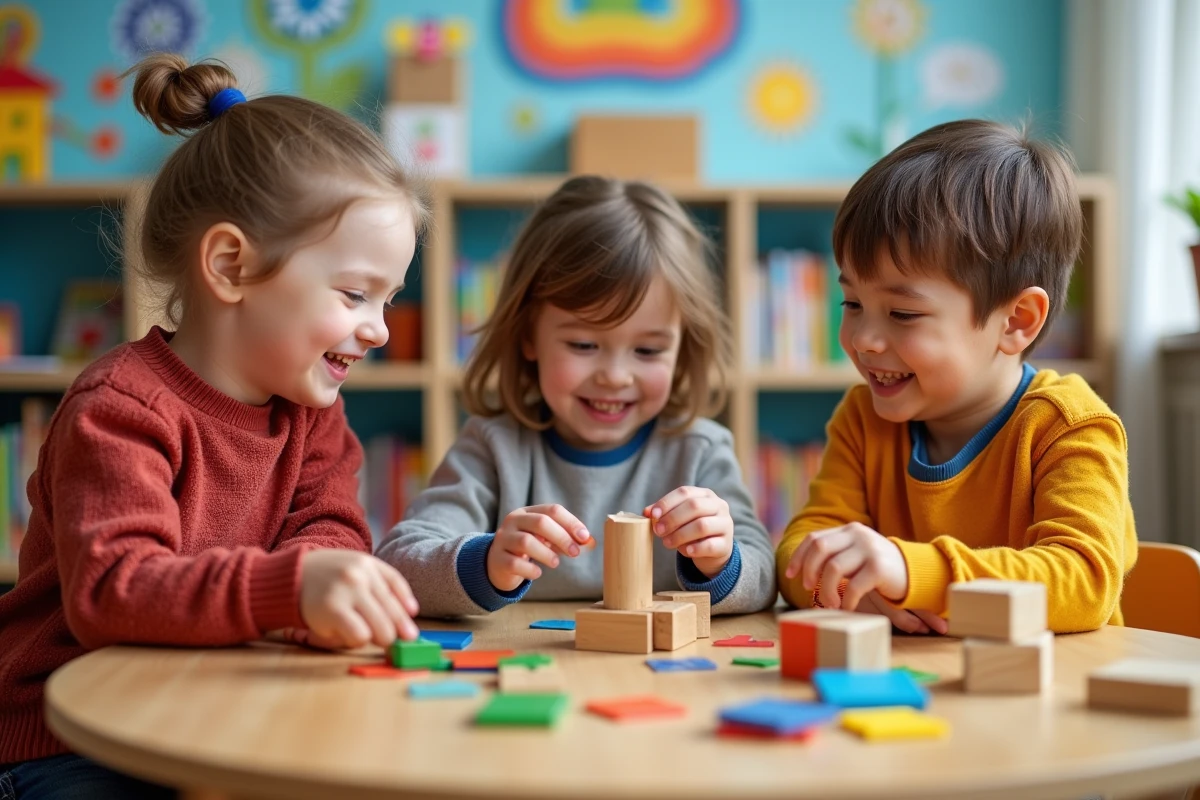
The idea that learning is limited to the school framework no longer holds up against recent playful innovations. Neuroscience confirms that manipulation, experimentation, and play promote the acquisition of new skills from a very young age.
The landscape of educational games is expanding rapidly. New tools are emerging, designed to meet the needs of each child, where old methods often fail to capture all the unique traits. This revolution is taking place in both specialized schools and families eager to offer something beyond the classic blackboard and monotonous recitation.
Awakening children’s curiosity: why sensory and educational games make a difference
Curiosity is anything but trivial: it propels the child into discovery and shapes their view of the world. From the earliest months, everything goes through the senses. A safe and suitable environment becomes a fantastic playground for exploration. The child manipulates, tests, retries, and appropriates each object in their own way. Montessori approaches and free movement, popularized by Emmi Pikler, show how freedom of movement and experimentation supports the development of confidence and autonomy. Regularly renewing toys and varying the materials keeps the door open for initiative and awakening.
It’s hard to underestimate the power of free play. Allowing the child to choose, repurpose, and imagine new uses for the same object gives them the keys to develop their creativity. Affordance, that famous principle that makes a toy intuitive, without instructions or guidelines, proves to be decisive: the child immediately understands what they can attempt, explores without blockage, and surprises themselves by inventing novel solutions.
The role of caregivers is crucial here: to support, accompany, and encourage while remaining in the background. The resources available at https://www.ouaps.fr/ provide a great example: a variety of games, careful safety measures, and attention to the inclusion of all profiles. The goal goes beyond simple entertainment. What is at play here is the construction of a strong bond between the child and everything around them, a fertile foundation for nurturing curiosity and solid autonomy.
What innovative games stimulate imagination and learning on a daily basis?
It’s impossible to overlook the vitality of the educational games market. Every day, new ideas emerge, blending pedagogy and sensory stimuli. Construction games are emblematic: they sharpen fine motor skills, encourage reasoning, and invite invention. The child assembles, deconstructs, retries, and adapts. Faced with a collapsing tower, they learn to think, persevere, and question their choices.
Role-playing and imitation games create a theater where each child takes turns being a cook, caregiver, parent, or explorer. With a puppet and miniature utensils, they tell stories, enrich their vocabulary, develop empathy, and learn to cooperate. Imagination finds an ideal ground to flourish here.
There are also games designed to engage the senses: materials to touch, sounds to recognize, colors to assemble. A playdough workshop, a texture box, a smell bingo: these are experiences that sharpen scientific curiosity while sparking creative desires.
As for board games, they remind everyone during each game how learning to wait for one’s turn, respect rules, and win or lose together are valuable lessons in their own right. It is often these shared moments that leave the most lasting memories.
To provide a clear view of the different categories of games available, here is an overview:
- Construction games: develop creativity and logic
- Role-playing and imitation games: stimulate language and imagination
- Sensory games: awaken perception and experimentation
- Board games: live and learn together
By focusing on variety, ease of access, and the ability to renew, these educational tools turn learning into a true playground. The child progresses at their own pace, without feeling trapped in a rigid or repetitive framework.

Resources, tips, and avenues for further exploration through play
The thirst for understanding, this taste for the unknown, is nurtured from childhood through hands-on activities and small experiments at home. For this, nothing complicated: a time capsule to fill with memories, a treasure hunt that transforms the living room into an adventure site, a mystery box where one guesses by touch, or even scientific experiments with everyday ingredients. At each workshop, the child asks questions, tries, sometimes fails, retries, and gradually understands how the world works.
The involvement of adults is crucial here. By sharing these moments, parents and children build trust and the joy of exploration together. It’s better to limit screens and favor games that stimulate concentration and the desire to create over time.
Here are some ideas to enrich this journey:
- Regularly offer creative hobbies: painting, modeling, crafting, gardening, depending on the moment’s desire.
- Organize outdoor explorations: collect leaves, observe insects, build an improvised shelter.
- Set up very simple scientific experiments: a baking soda volcano, light and shadow games, testing what floats or sinks.
The key is to find the right balance between freedom and guidance. By renewing activities, allowing the child to choose, and sharing with them, the playful universe becomes an endless adventure ground. Day by day, curiosity and imagination unfold, far from marked paths and rigid routines. And what if the next inventor or explorer is already building their rocket with Kapla, just a stone’s throw away from us?